

How to Choose an Upholstered Bed Frame That Suits Your Bedroom’s Scale
Choosing an upholstered bed frame starts with measuring the usable space in your bedroom and comparing the frame’s full dimensions, not just the mattress size. Consider headboard height, footboard style, fabric, colour and surrounding furniture to achieve balanced proportions. Leave comfortable walking space, test the layout before buying and assess how storage options affect the room. Careful planning helps you select a bed frame that feels comfortable, practical and visually suited to your bedroom for years to come.
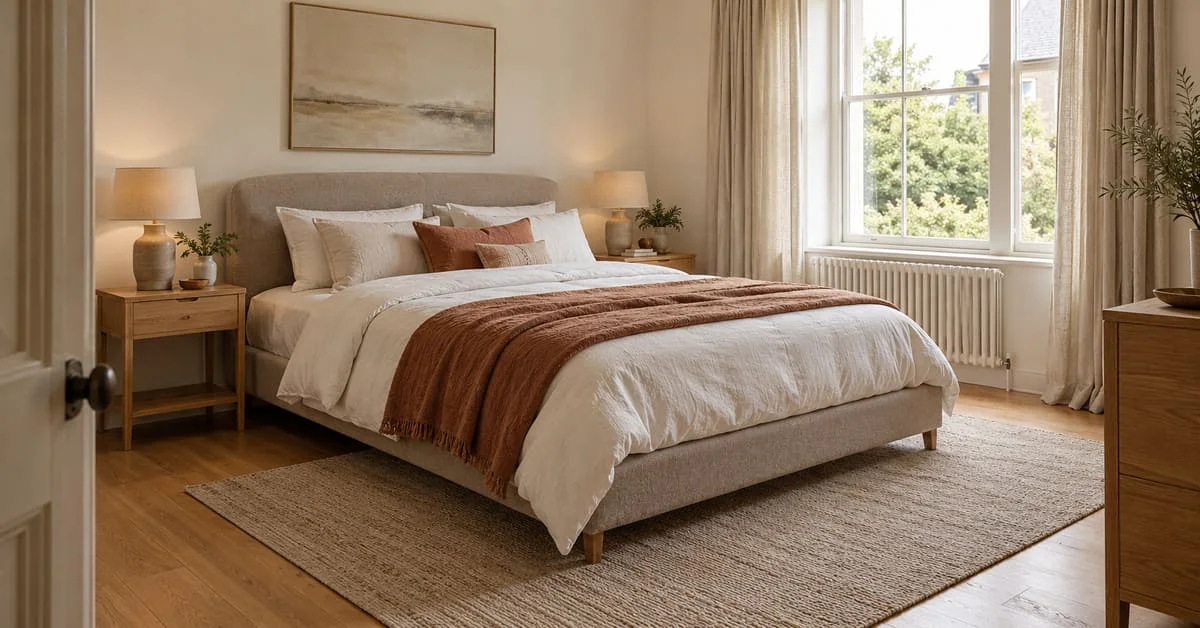
Choose an upholstered bed by checking its complete footprint first, then judging how its height, shape and fabric sit within the room. A frame can fit between two walls yet still leave the bedroom feeling crowded. Equally, an understated bed can look lost against a broad, empty wall. The aim is a comfortable sleeping space with clear routes around it and proportions that feel deliberate.
Measure the space you can actually use
Start with a simple floor plan showing the room’s width and length. Add fitted wardrobes, chimney breasts, radiators and the bedroom door’s opening arc. Measure between the nearest obstructions, including skirting boards, rather than assuming the wall-to-wall dimensions are entirely available.
Next, mark where you walk when getting dressed, opening curtains and reaching storage. A bed positioned neatly in the centre may still interrupt the route from the door to the wardrobe.
Use masking tape suitable for your flooring to outline a shortlisted frame. Walk around it and open every nearby door and drawer fully. This quick rehearsal often reveals an awkward corner that a floor plan misses.
Compare the outer frame dimensions with the mattress size
Size labels such as double and king refer to the sleeping area. Padded side rails, projecting headboards and shaped footboards add to the space the bed occupies. Two upholstered frames taking the same mattress can therefore fit quite differently.
When comparing upholstered bed frames, check the maximum assembled width and length for your chosen size. If a page gives only mattress options or headboard measurements, ask for the missing dimensions before ordering.
As a practical starting point, aim for around 60 cm of clear walking space along the sides you use and at the foot. Allow more where you dress, open furniture or need easier access.
For example, a frame measuring 160 cm across leaves 70 cm on each side within a clear 300 cm width when centred. Any furniture projecting into those routes reduces that allowance. Calculate from the frame’s widest point, including headboard wings.
Match the headboard to the wall and ceiling
Assess the headboard against the visible wall behind it. A tall design can give a broad, uncluttered wall a focal point, while a lower outline may sit more comfortably beneath a sloping ceiling or alongside low furniture.
Mark the proposed height on the wall with removable tape. Look at it from the doorway, where you first take in the bedroom, and check its relationship with wall lights, pictures and window sills.
The Messina upholstered bed has a deep-buttoned headboard listed at 49.5 inches, approximately 126 cm. Its detailing makes it worth considering when you want the headboard to draw attention. Mock up that height before choosing it for a room where the wall already carries several features.
Consider how the footboard changes the view
The foot of the bed often faces the doorway, so its outline strongly affects the first impression. A low, simple footboard keeps more of the mattress and room beyond visible. A substantial or curved end gives the bed a more enclosed, prominent appearance.
The Ferrara sleigh bed features scrolled head and foot ends, deep buttoning and dark turned wooden legs. Those details make it a useful option to consider for a spacious bedroom needing a stronger centrepiece. Check the full end-to-end measurement carefully: the scrolled shape must fit within your planned footprint.
In a short bedroom, compare a straighter frame before reducing the mattress size you need for comfort.
Use fabric and colour to control visual prominence
Once the dimensions work, decide how strongly you want the upholstery to stand out. For a quieter effect, choose a shade close to the surrounding walls. For a deliberate focal point, consider a stronger contrast.
Texture matters too. Deep buttoning, pronounced seams and lustrous fabric create more visible detail than a plain upholstered surface. In a compact bedroom with patterned curtains or wallpaper, simpler upholstery can keep the overall composition calmer.
Ask whether fabric samples are available, and view them vertically beside the bed wall in daylight and lamplight. A small screen image cannot reliably show the finished effect.
Balance the bed with neighbouring furniture
Judge the bed and bedside tables together. Wide cabinets can make a modest frame feel squeezed, while very small tables may look disconnected beside a substantial headboard. Include their widths when planning the bed wall, along with access to sockets.
Check height as well. Add the intended mattress depth to the height of the mattress support to estimate the finished sleeping surface. Then compare that level with your bedside tables so drinks, books and switches remain easy to reach.
In a larger bedroom, try more substantial bedside furniture or better lighting placement before automatically choosing a bigger mattress. These adjustments can give the arrangement presence without changing your sleeping space.
Decide whether storage improves the whole layout
An upholstered storage bed may justify a deeper-looking base if it lets you remove another piece of furniture. Judge the space saved across the bedroom, rather than assessing the bed in isolation.
The Ancona upholstered bed is described with sprung slats and gas-lift access to storage underneath. It is worth considering where spare bedding currently occupies a separate chest or blanket box.
Before choosing any lifting base, confirm the opening direction and operating clearance. You need room to stand and lift it, with no conflict between the raised mattress and nearby fittings. Storage adds value when you can use it comfortably in the finished layout.
FAQs
Can an upholstered bed sit beneath a window?
Yes, if the headboard leaves the window usable and does not obstruct curtains, handles or a radiator. Measure the sill height and check the window’s opening movement before choosing.
Can a headboard be wider than the mattress?
Yes. An extended headboard can create a deliberate backdrop, but its widest point must fit the wall and leave room for bedside furniture, sockets and access.
Will oversized bedding make the bed look bigger?
It can. A heavy duvet hanging low over the sides hides the legs and strengthens the bed’s visual presence. Check the proportions with bedding similar to what you intend to use.
How should I judge scale from product photographs?
Treat photographs as style references. Camera angles and room staging can distort apparent size. Recreate the listed measurements at home before deciding whether the proportions suit your bedroom.