

Choosing a Handmade Dressing Table with Storage for Jewellery and Cosmetics
Choosing a handmade dressing table starts with understanding how you store jewellery, cosmetics and everyday essentials. Compare drawer layouts, internal storage, surface space and seating comfort to find a design that suits your routine. Measure your collection, organise items into dedicated compartments and ensure there is enough room for mirrors, lighting and accessories. A well-planned dressing table provides practical storage, keeps everything organised and creates a comfortable space for daily grooming.
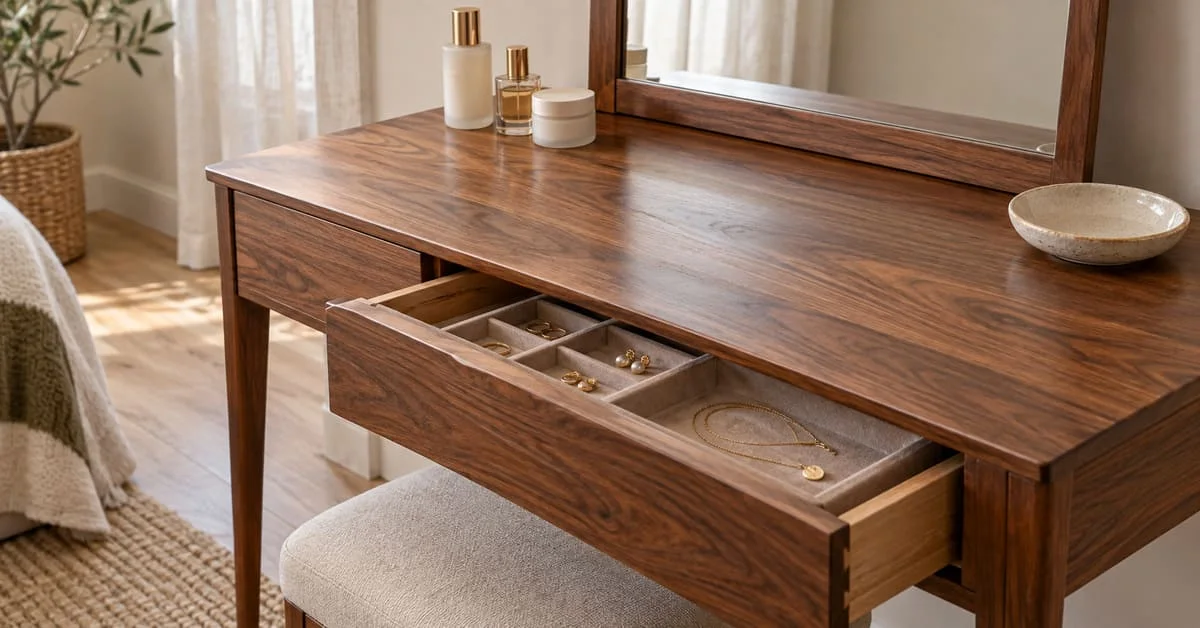
Choose a handmade dressing table by matching its usable storage to your jewellery and cosmetics, then checking how comfortably it fits your room. Drawer count matters, but so do internal depth, space for organisers and the height of the seat beneath it. A table that accommodates your collection without crowding your morning routine will be easier to live with long after the bedroom is decorated.
Start with your everyday collection
Lay out what you intend to store before comparing furniture. Separate everyday makeup, skincare, jewellery and occasional-use accessories. Measure your tallest bottle, widest palette and any jewellery box you want to keep.
Think about access as well as quantity. Earrings need small compartments; necklaces need room to lie separately; bulky toiletry bags need a larger uninterrupted space. Allow some spare capacity for changing products, without buying a much wider table for items you rarely use.
Sketch a simple drawer plan. If everything needs stacking several layers deep, reconsider the layout before ordering.
Match the storage layout to your routine
Different configurations suit different collections. These Woodlands designs provide useful starting points; the dimensions below are the listed overall measurements, not internal storage sizes.
For a modest collection, the Dewsbury three-drawer dressing table is worth considering: you could allocate separate drawers to jewellery, daily cosmetics and occasional essentials. Check that each drawer accommodates the organisers you intend to add.
The Cambridge four-drawer model provides another compartment within a narrower overall width. That makes it a useful shortlist option where wall space is limited, although its greater height needs checking against your seating.
For more categories, consider the Cambridge eight-drawer dressing table. You could separate lip products, eye makeup, skincare and accessories more finely. Eight drawers do not establish total capacity, however; compare their internal measurements with your collection.
The Dewsbury three-drawer and one-door design offers a different arrangement, with one shelf inside the cupboard. Consider it for larger bags or containers, subject to checking shelf clearance. Do not assume the shelf is adjustable.
Give jewellery its own protected space
Plan a dedicated jewellery drawer with removable, softly lined compartments. Separate earrings into pairs, give rings individual spaces and lay fine chains apart so they are easier to pick up without tangling.
Ask for the drawer’s usable width, front-to-back depth and closing clearance before buying inserts. A tray that fits through the opening may still be too tall once bracelets or watch cushions are added.
Check how far the drawer opens, too. An organiser loses much of its usefulness if the back compartments are awkward to reach. Treat linings and dividers as accessories to arrange separately unless the product description expressly includes them.
Make cosmetics easy to see and clean around
For makeup, choose a layout that lets you identify products without emptying the drawer. Palettes can sit flat if space permits; smaller items benefit from removable sections that prevent them disappearing beneath larger cases.
If bottles will stand upright, measure them with their pumps or caps attached and allow room to lift them out. Use suitable removable, wipe-clean containers for liquids, keeping them separate from jewellery and fabric-lined trays.
Reserve a clear working area on top for the products you are using. Account for the footprint of a freestanding mirror and lamp before deciding how much surface space remains.
Check seated comfort and room clearance
Mark the table’s footprint on the floor, then pull out your intended stool or chair. Check that you can sit down, move your legs and open the drawers without blocking a wardrobe or catching the bed.
Overall height does not tell you the height beneath the tabletop. Request the knee-space width and underside clearance, particularly where a central drawer reduces legroom. Compare these with your seat height and your preferred sitting position.
Position the mirror so you can use it without leaning forward constantly. Check nearby sockets and plan lighting that illuminates your face without leaving cables across the drawers or walking route.
Choose materials and finishing details deliberately
Read the material description for the exact model. If solid pine is a priority, the Dewsbury solid pine six-drawer dressing table in Kenilworth wax explicitly lists that construction. Its six drawers make it another option for separating a broader collection, while the wax finish suits a preference for visible wood character.
For painted furniture, compare a finish sample beside your existing bedroom furniture in daylight and evening light. Consider handles practically: can you grip them comfortably when opening a drawer repeatedly?
Runner options vary between models. The three-drawer Dewsbury White offers traditional, metal and soft-close choices, while the Cambridge models above list traditional and metal runners. Check the selected product’s options before budgeting for upgrades.
Confirm the complete order
Where standard dimensions fall short, discuss the required changes before ordering. Give exact measurements and explain what must fit inside; a request for extra bottle clearance is more useful than simply asking for deeper drawers.
Get the final specification and total cost confirmed, including finishes, hardware, mirror, seating and delivery. Check the delivery route through doorways and stairs. Woodlands’ delivery information distinguishes standard doorstep delivery from an additional room-of-choice service, so arrange the help your room requires.
Frequently asked questions
Do handmade dressing tables include a mirror and stool?
Some sets do. The Dewsbury large-mirror dressing table set explicitly includes both. Check each listing before comparing a set with a table-only price.
Can I use a dressing table as an occasional desk?
Yes, if its surface, knee space and seating suit you. Check that your laptop fits alongside the mirror and that cosmetics can be cleared away easily.
Should all my cosmetics stay on the tabletop?
Keep out only what you use regularly. Store other items where their labels advise, and avoid choosing a position that exposes the collection to direct sun or radiator heat.
Can two people share a dressing table?
Yes. Allocate each person their own drawers, agree which products belong on top and check that the mirror and seating work for both users. Separate storage makes shared routines simpler.